
STUBBORN KINDA FELLOW -
The Troubled Life and Tragic Death of Marvin Gaye

May 21st 1971 - was the release date of one of the most important records of all time and certainly the most significant issued on the MOTOWN label - The album - What’s Going On ? by Marvin Gaye
To mark the anniversary of that event, I take a look at the remarkable career of the astonishingly talented yet troubled Prince of MOTOWN
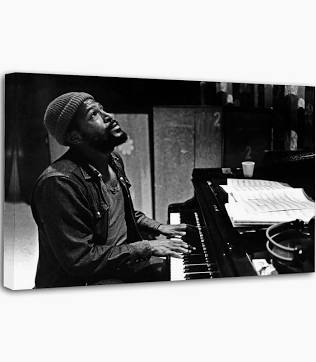
MARVIN GAYE - Born April 2nd 1939 - Died April 1st 1984 - Aged 44 years.
It is often said that fact is stranger than fiction. In the traumatic life of the silkiest of soul singers that is absolutely accurate. Complicated, sensitive, and passionate , Marvin Gaye lived his life overshadowed by his violent father.
That difficult, explosive relationship underpinned everything in Marvin’s life. Ultimately, and tragically it would end in father shooting son after their final, fatal argument on April 1st 1984.
On April 2nd 1939 Marvin was born in Washington DC as Marvin Pentz Gay. He added an E to his name in the early 1960’s to avoid teasing about being gay and to distance himself from his violent father’s surname.
His father Marvin Gay a Reverend in a Hebrew Pentecostal church called the House of God. He was very strict with Marvin junior and his 3 siblings. He was a brutal man, often inflicting physical violence on his children and wife .
This savage upbringing, left Marvin Junior scarred for life. He forever craved the attention of his father who rebuffed his son repeatedly. Despite his career achievements he never achieved the thing that he desired the most….. his father’s love.
Unsurprisingly, Marvin wanted to flee from his family as soon as possible. His first attempt to escape was in 1956. Aged 17 he enlisted in the US Air Force. But very quickly, he faked mental illness to extricate himself from the highly regimented environment.
He returned to Washington DC and formed a vocal quartet called The Marquees. After one failed single they were dropped from their recording contract with Okey records a subsidiary of Columbia.
One of the few positives that Marvin took from his father, was his preaching style and he readily acknowledged that it played a key role in his vocal delivery.
As a singer, the young Marvin was influenced by Frank Sinatra, Nat King Cole, Ray Charles and Billy Eckstine. After the initial failure of The Marquees, he continued working in Washington DC on the club circuit and started writing his own songs.
ENTER STAGE LEFT - HARVEY FUQUA
Eventually the impresario Harvey Fuqua spotted Marvin and took him under his wing. Harvey would become the father figure that Marvin had always craved. He had already discovered Johnny Bristol, Lamont Dozier, Junior Walker and The Spinners.
In 1959 Harvey Fuqua and his group The Moonglows moved to Chicago where they recorded a few unsuccessful tracks for Chess Records. With little sign of success the group split.
Then in 1960 Harvey and Marvin moved to Detroit, where MOTOWN was about to become the Sound of Young America. They would become very big cogs in the Motor Town machine.
On arrival in Detroit, Marvin became a session musician, a drummer. His fortunes changed when he was invited to the home of Berry Gordy over the Christmas of 1960. That assignation would change his life and the history of soul music to boot.
He married Anna Gordy (Berry’s sister) seventeen years his senior, in June 1963. The relationship was intense, passionate and fiery . They were good for each other and the marriage kept Marvin close to the ear of Berry at the “Hit Factory”.
Nonetheless, Berry was always grudging in praise of his brother in law. But he was keen to use Marvin as the leading male vocalist for MOTOWN. He saw Marvin as a cross between a matinee idol and a pop star.
MANY MOTOWN WRANGLES
Many people at MOTOWN recall strenuous arguments between Marvin and Berry Gordy. They often had heated squabbles but Berry held the aces.
Financially he called the tune and Marvin sang the songs that Berry demanded (at least initially). Berry also owned the house that Marvin and Anna lived in.
MOTOWN wanted Marvin to sing simple, unthreatening, uncontroversial, pop songs. Berry aimed to sell records in huge numbers and not make political or social statements. He didn’t want to alienate the middle of the road, largely white, record buying public.
Berry did not want to present MOTOWN as aggressive or dangerous. In many ways he was doing what Brian Epstein did with The Beatles. Keep it clean, don’t threaten, dress sensibly and get hits.
Berry Gordy was selling pop, upbeat, happy music and money was the driver. He was a ruthless businessman first, second and third.
Marvin had the looks, the voice and star quality, but Berry wanted him to be someone that any girl could happily take home, to meet her parents.
The first hits Marvin had on MOTOWN reflected the “safe” music that the company ordered. In 1962 “Stubborn Kind of Fellow” was typically risk free material . It was definitely not the music that Marvin dreamed of making but it was successful.
Success followed success and Marvin worked with the genius in house MOTOWN production team, Holland-Dozier-Holland, and the hits kept coming. So “Can I Get A Witness”, You’re A Wonderful One” and “How Sweet It Is To Be Loved By You “ hit the charts.
Firmly established as MOTOWN’s leading man, Marvin was pushed by Berry into series of duets with the leading ladies on the label. Reluctantly, Marvin agreed and the recordings produced some great moments.
He duetted with Mary Wells “What’s The Matter With You Baby ?”, then with Kim Weston “It Takes Two”, and most successfully with Tammi Terrell “Ain’t No Mountain High Enough”, Ain’t Nothing Like The Real Thing”, and “You’re All I Need To Get By”.
Later Berry cajoled him into recording with Diana Ross although they never actually set anything down at the same time. They despised each other.
THE PRINCE OF MOTOWN
The Prince of MOTOWN he may have been but privately Marvin was in torment. He was deeply hurt by having to dance to Berry’s tune. He wanted to record his own more contentious, expansive music.
Like Stevie Wonder he became frustrated at the limitations the were being imposed on them . They were growing up and wanted to reflect the social, economic, political and environmental issues that were confronting the United States at the time.
By the late 60’s the relationship between Marvin and Berry was frosty, at best. Typical of the shenanigans was the saga that went on with the Norman Whitfield and Barratt Strong tune “ I Heard It Through The Grapevine”. It was recorded by Marvin in February 1967 but MOTOWN rejected it suggesting it be covered by Gladys Knight and The Pips.
Only when released as an album track on Marvin’s LP “In The Groove” in August 1968 did radio stations give it plenty of airplay that demanded it be released as a single.
His rendition reached number 1 on US pop and RnB charts and became a world wide hit. A victory of sorts for Marvin but the next skirmish with Berry was not long in coming.
In May 1969, Obie Benson of the Four Tops was working on a song for the Tops, called “What’s Going On ?”. It was rejected by the them because it was a protest song.
Their loss was to be Marvin’s gain and it would result in arguably one of the most important MOTOWN albums ever recorded.
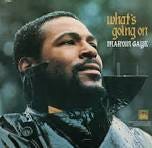
WHAT’S GOING ON ? - REJECTED BY THE TOPS, ACCEPTED BY MARVIN
Anna Gordy persuaded Marvin to try the song “What’s Going On ?” and it seemed that it was perfect for him. The studio singers, musicians and engineers were convinced he had to record and release the song. But Berry Gordy was annoyed that Marvin was contemplating doing so.
According to Berry , if the Four Tops believed the song to be inappropriate then it WAS. It was a “protest” song and MOTOWN did not do anything that might rock any boats. Berry forbade Marvin to record the song. Effectively Marvin then went on strike, refusing to record at all.
The impasse lasted almost a year, until in June 1970 permission was granted for the single “What’s Going On ?” to be recorded by Marvin. When it was eventually released it was done without the knowledge or sanction of Berry Gordy.
The strike period gave Marvin time to compose a series of songs he wanted to release on a concept album with “What’s Going On ?” as the title track. His contentious piece of work became one of the most important records ever made and certainly the most radical put out by MOTOWN.
The album openly challenged the existing social order. He sang about civil rights, poverty, Vietnam, environmental abuse, intolerance. The record became a clarion call for anyone wanting to question the politics of the time. Lyrically and musically it was a huge departure for the Hit Factory.
As a political record, Berry Gordy did not want to release the album and he did not believe it would be a hit . It was far too serious.
MOTOWN was light hearted, fun pop. Marvin was talking about climate change before the scientists talked about it and he sang in a more jazz influenced style than the RnB/pop that was the hallmark of the Detroit label.
It was soul music’s first true concept album. Its’ musical style is a seamless blend of progressive soul, psychedelic soul, and jazz, heavily layered with lush orchestral arrangements, Latin percussion, and gospel harmonies.
The record is a continuous, stream-of-consciousness, a musical suite rather than a collection of normal three-minute pop songs.
ONE OF THE ALL TIME CLASIC ALBUMS
The album “What’s Going On ?” was released in May 1971, and it became the biggest selling album on MOTOWN to that point. It fused social commentary, politics, jazz , funk and soul to endure well beyond its’ time.
It is still one of the most important records ever made and the messages it carries are perhaps more relevant now than when it was released.
Following “What’s Going On ? “ was always going to be a huge challenge but throughout the 1970′s Marvin continued to experiment with jazz, gospel, blues, soul and even more with narcotics.
He managed to balance spirituality, commerciality, and experimentation with hits such as “Let’s Get It On”, “Trouble Man”, “After The Dance” and “Got To Give It Up”.
In his personal life he eventually divorced Anna Gordy in 1978 after a pained, strained marriage.
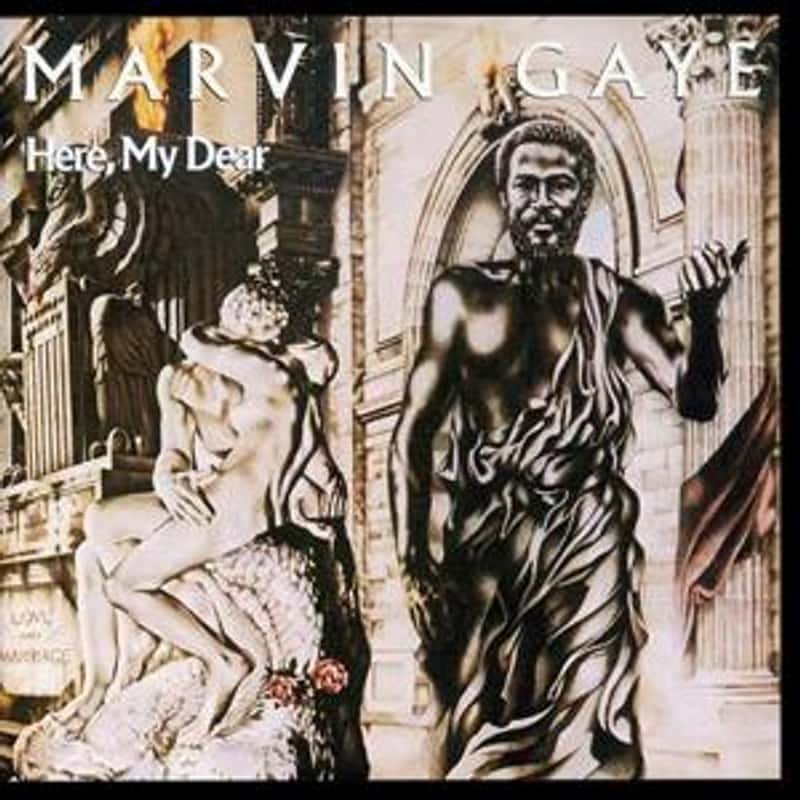
Here, My Dear - one of the most rancorous records you are likely to hear.
The traumatic separation inspired him to record the album “Here My Dear” , probably the most bitter record you will ever listen to. Marvin left no doubt that he was in a deep emotional hole. His drug use fuelled terrible and dangerous mood swings as he lurched from one instability to another.
A short lived second marriage to Janis Hunter lasted only until 1979 with divorce finalised in 1981. Marvin found himself bankrupt financially and emotionally and he attempted to take his own life.
A COMEBACK ON COLUMBIA
In 1982 with the aid of old friend and mentor Harvey Fuqua, Marvin made a comeback. Exiled to Britain then Belgium he released the single “Sexual Healing” on Columbia Records.
The track was taken from the album “Midnight Love” which had some more than decent high moments. As usual for Marvin, he fused a number of different musical influences from reggae, RnB, soul, funk and synth pop.
The success of the 1982 “comeback” allowed Marvin to clear 2 million dollars in back taxes to the US authorities. Sadly off stage, Marvin could never fend off his personal demons.
A TRAGIC END ON APRIL FOOL’S DAY
Stage fright, paranoia, drug use and ongoing depression eventually confined the “Prince of Motown” to his Los Angeles home. It was a home where he would lose his life.
As if somehow predestined, Marvin Gaye was shot dead by his father on April 1st 1984. Yes indeed, April fools day. You couldn’t make it up could you ?
In a violent argument and fight between his mother and father, Marvin intervened and the situation escalated quickly into the final, fatal act of the ultimate tragedy.
His father was charged with first degree murder but eventually this was reduced to manslaughter following the diagnosis of a brain tumour. He was sentenced to a six year suspended sentence and probation. He died in 1998 in a nursing home.
Marvin Gaye will always be remembered as one of the most important voices ever to be recorded. In the pantheon of male vocal greats, he is up there in the top echelons.
In my opinion, and that of many others more learned than me, he is in the same company as Frank Sinatra, Tony Bennett, Sam Cooke, Jackie Wilson, David Ruffin, Wilson Picket, Otis Redding, Donny Hathaway, Ray Charles, Nat King Cole, and now Gregory Porter.
His work remains as relevant today as it was when it was recorded. The sentiment and messages delivered on the “What’s Going On ?” album were years ahead of their time .
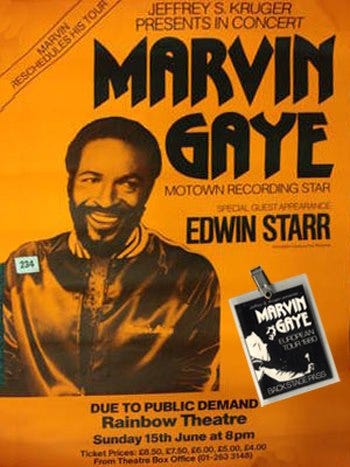
Concert Poster from 1980 - Marvin Gaye supported by the late, great Edwin Starr - I was fortunate indeed to attend.
HIS FATHER’S LOVE WAS ALL HE CRAVED
Nothing in his successful music career however, could compensate him for the love and recognition he craved, but lacked from his father.
I was privileged to see Marvin live in 1980 at the old Rainbow Theatre, Finsbury Park , London. The inter web tells me it was June 15th and the late, great Edwin Star supported. Clearly well past his best he was still head and shoulders above most other vocalists, supposedly still in their pomp.
Marvin’s performance, proved that soul music wasn’t just about sound, it was about truth, vulnerability, and reaching for something higher.
It is still hard to believe that a little under two years later he would be killed by his own father at the tender age of 44.
In life Marvin Gaye was a restless, troubled, tragic soul. He had the voice of an angel, the demons of the devil and a tempestuous life.
Marvin Gaye leaves an incredible body of work and a wonderful, timeless musical legacy.
May he rest in peace.
FURTHER READING
Where Did Our Love Go - The Rise and Fall of the Motown Sound - Nelson George
Divided Soul - The Life of Marvin Gaye - David Ritz
OMG Anthony, this brings back old, old memories. At this time i was big into music & Marvin Gaye, although everyone knew how troubled he was at the time. But it was almost incomprehensible & a tragedy that his own Father would be the one for his demise - that is actually kill him. No one at the time forgave his Father, i mean no one, anger & grief was so intense the life of Gaye Sr. was thought to be in danger. But that Sr. should have gotten off so lightly led to further enragement & demands for justice. I read too that the other family members never forgave Sr. either. Marvin Gaye Sr. & Joe Jackson were & i think still are, regarded as the most abusive, bully-fathers in the history of the music industry. What memories you have brought forth with this article.