
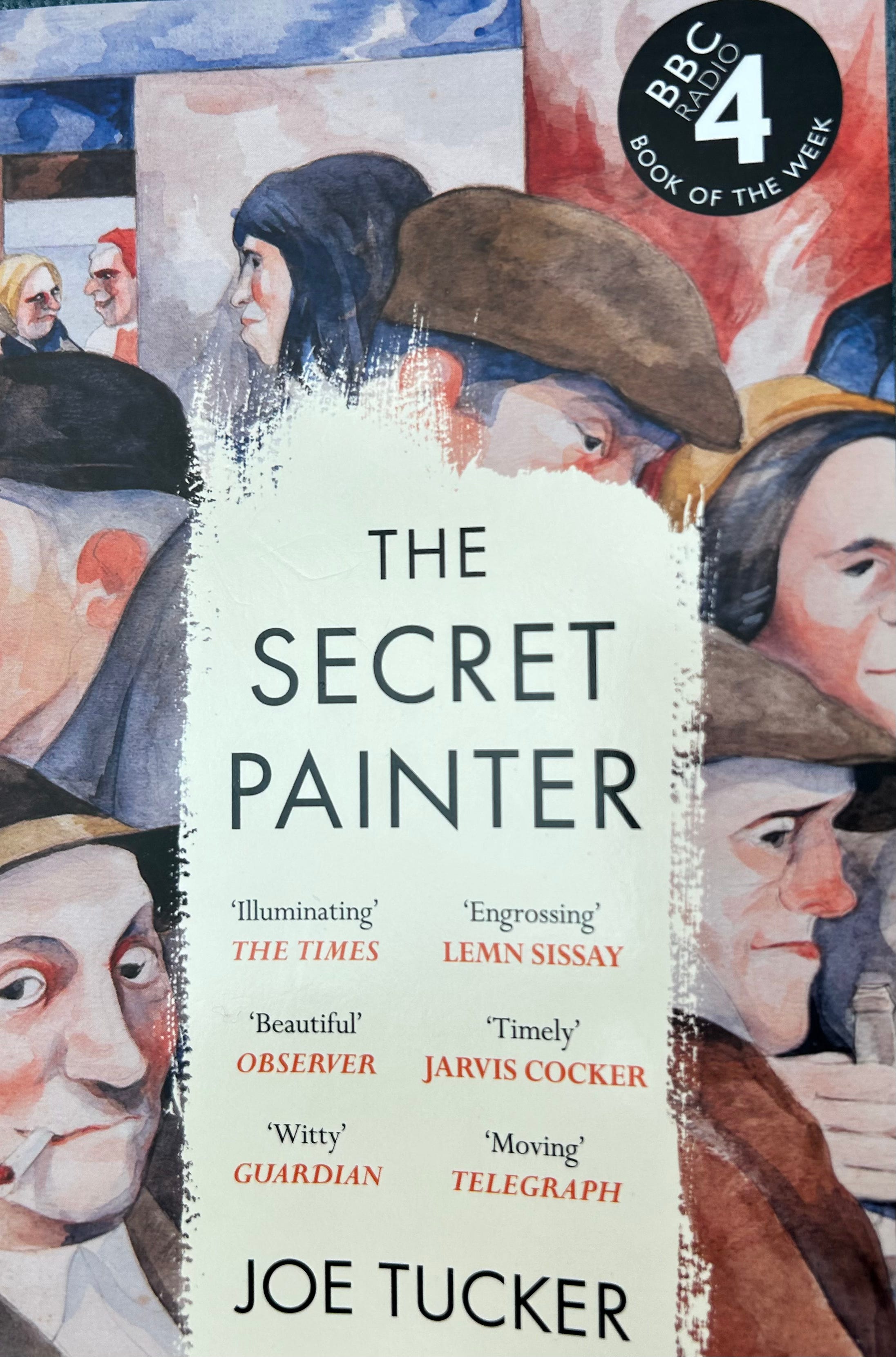
THE SECRET PAINTER
The unlikely, uplifting and remarkable story of clandestine artist Eric Tucker

AN ORDINARY MAN LIVING AN ORDINARY LIFE , MAKING EXTRAORDINARY ART
I have been meaning to write an account of the amazing and inspiring book, The Secret Painter by Joe Tucker for a while now. I first read it last Autumn and have since then, re-read it twice.
It tells the story of Joe Tucker’s uncle Eric and the secret life he led as an undercover artist.
It is a story that reminds us that we should never underestimate anyone, and acknowledge that talent comes from so many different people, presenting itself in so many different ways.
For me the book was inspiring, thought provoking, funny, sad, uplifting and remarkable in equal measure. I hope that my review will encourage others to read Eric’s amazing tale.
Someone like Eric Tucker is not a man that many people would have heard of. He was an unremarkable man, living in a Northern English town, going about a wholly undistinguished life.
And yet, here was this ordinary man with modest ambition, who had secretly been painting for 60 years. He portrayed the life that unfolded around him and the characters, he encountered in that time.
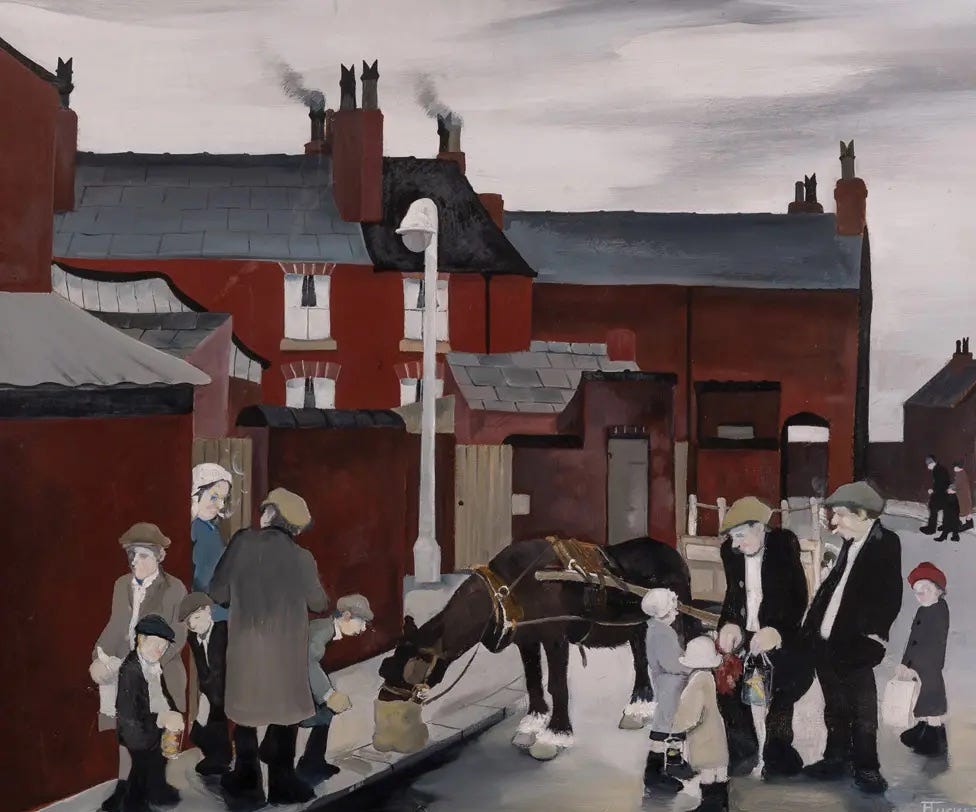
His work depicted mostly working class social life in the North West English town of Warrington. He has, since his death been compared to L S Lowry and an obvious influence can be seen in his work, but there is a major difference.
Lowry was solidly middle class, representing working class scenes in his art, whilst Eric Tucker was a working class, eccentric man portraying his own working class background. An accurate picture of his life and times, from the inside, so to speak.
I have always been drawn to people who are different, perhaps even eccentric, who often have a streak of genius within. The late, Eric Tucker was one of those very people and his story deserves to be better known.
WHO WAS ERIC TUCKER ?
The reluctant hero of this astounding story was born in 1932 in Warrington. He lived his entire life in the town with a few notable breaks, including his national service in the army and a spell in his twenties working as a labourer in South Wales.
He received no formal art training or instruction. Having left school aged fourteen in 1946, he was apprenticed as a sign writer but never took up work in that trade. Instead he took a host of labouring jobs, eventually working for a local construction company, loading and unloading lorries.
A great lover of comedy, and a talented boxer in his youth, he also had a great passion for the circus and these loves all featured in his art.
Only two of his paintings were sold in his life time, at the Tib Lane Gallery in Manchester, although he was very reluctant to sanction them even being displayed.
He never married, didn’t have a partner or children and apart from his stint in the army and labouring in South Wales, he never left the council house that his Mother and Step Father rented.
After his Mother died he remained in the family home and passed away there, aged 86 from heart failure.
Since his death in 2018, his brother Tony, his nephew Joe and the wider family catalogued his entire collection and self staged an exhibition of his work.
The first of these was at his former home in Warrington, then at the Warrington Museum and Art Gallery in 2019, and in 2021 at two London art galleries.
His work has been compared to Edward Burra (his favourite artist), L S Lowry, James Ensor and Edgar Degas.
Art critic Ruth Millington described Tucker’s work as a ‘significant contribution to modern British art’.
SKELETONS IN EVERY CLOSET
For such an unremarkable man, it came as a huge shock to his surviving family, that Eric Tucker had almost surreptitiously, created about 500 paintings and thousands of sketches and drawings.
Over a sixty year period, he had been creating art from the day to day life he encountered in the clubs, pubs, streets, avenues and alleyways. Images of the world he knew and the characters that shared it with him.
His family had known that Eric had an interest in art. They were aware that he had produced a few pieces of work, but absolutely no idea that his oeuvre was so extensive and frankly so very good.
The vast majority of his work had been seen by nobody but him. He really was the secret painter, prolific and staggeringly talented yet completely unknown.
When his brother Tony and his nephew Joe (the author of this excellent biography) discovered the vastness of Eric’s collection, they found art tucked away in every available space.
So many skeletons in so many closets. From cupboards to wardrobes, old compost bags, the garden shed, every nook and cranny that the house afforded, crammed with six decades worth of art.
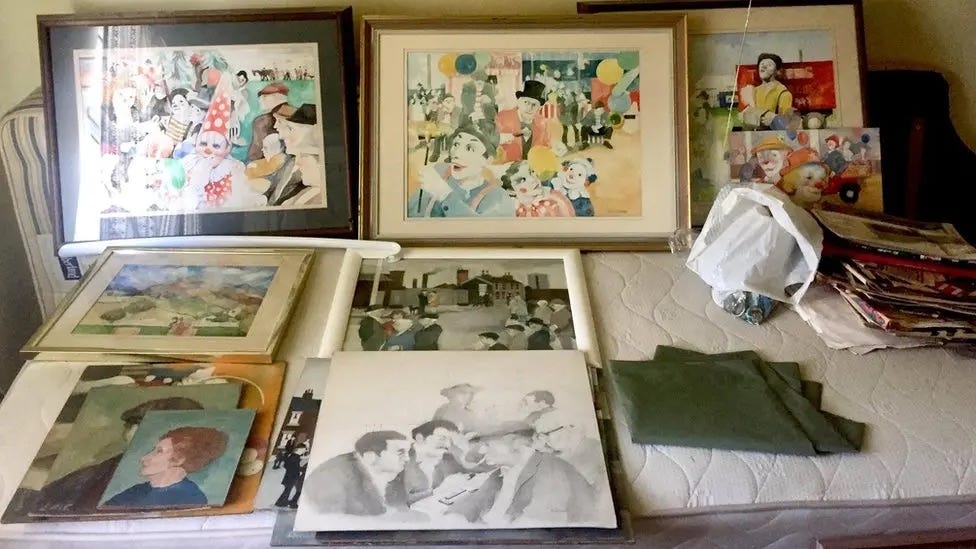
Picture credit - Joe Tucker - Eric Tucker had numerous paintings, drawings and sketches hidden in every nook and cranny of his home.
WIRED DIFFERENT
The North West town of Warrington, could not be said to be a hot bed for arts and culture.
In 2015 it was listed by the Royal Society of Arts at the bottom of its’ Heritage Index, which ranked towns, cities and areas of the UK, by quantity of cultural assets compared to relative geographic size.
So Warrington was labelled, “Britain’s Worst Town For Culture “ by many of the national newspapers.
The town is predominantly working class, industrial and probably somewhere that most people pass through on their way to somewhere else.
Warrington is 16 miles east of Liverpool and 16 miles west of Manchester. It is famous for its’ manufacturing base, notably steel (especially wire), textiles, chemicals, tanning and brewing.
In more recent times, like many industrial towns, it is now rooted in retail and leisure. IKEA and ten pin bowling are the big draws.
The town is also famous for its’ rugby league team the Warrington Wolves (historically nicknamed “The Wire”).
Coming from this environment, it is even more remarkable that the unexceptional Eric Tucker should produce such a wholly distinguished body of work, whilst keeping it largely in secret.
Here was a man, who was clearly wired different. On the surface he was living a completely undistinguished life, he appeared to be a bit of a shambling, shuffling sort of idiomatic character who lived a quiet, routine life.
He repaired holes in his clothing with sellotape and never discarded anything, that could become useful in the future. He used tape on a broken window in his car and referred to it as stained glass.
And yet, he kept his artistic light under his bushel and his very real talent hidden from any kind of audience until he died.
EXTROVERTED INTROVERT - An AMBIVERT
That Eric Tucker was a man of many contradictions is made pretty clear by the biography A Secret Painter.
He was someone who could be the centre of attention amongst company that he knew, but who was suspicious of just about anybody else.
He was especially dubious of people in authority, private institutions, and professionals of any kind.
He loved socialising but there was something very solitary about him, albeit he never came across as lonely.
His passion for art was largely fuelled by visits to the public galleries in Manchester, The Whitworth and The Manchester City Art Gallery, which he would explore on Saturdays.
He would indulge his passion for art and then take a few drinks in City centre hostelries, observing and quietly absorbing the characters in his midst.
He preferred the company of the very lowest in society, where according to him, the poorest people provided the richest material.
His flair for art was kept so carefully hidden, that he would quietly undertake sketches in pubs and clubs without revealing what he was doing.
He always carried scraps of paper, grubby notebooks and pencils to capture the people and places he encountered.
None of his subjects had any idea that he was recording them. He shared very little of his work with family, let alone strangers.
He loved people, but only those he considered to be his people. In their company he was comfortable even gregarious, but at the same time, he was often sketching them surreptitiously.
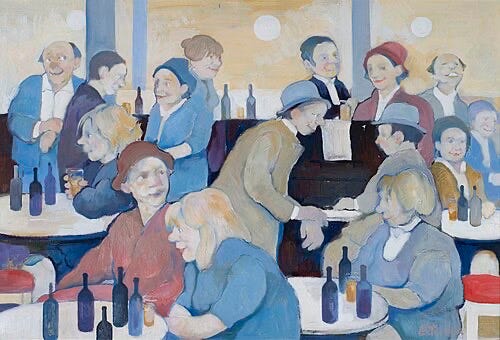
Temptation - one of Eric Tucker’s many paintings of working class life in pubs & clubs
SUSPICIOUS MINDS
The suspicion and doubtful view that Eric Tucker had for anyone in authority was a key factor in him never pushing himself and his work forward.
He had mentioned to his brother and close friends & family that one day he might like to see his work exhibited, but lack of trust and perhaps an inferiority complex stunted that ambition.
It has to be put into the context, that here was a working class man, with no formal art training or education after leaving school at 14, potentially opening himself up, to the art world which was and still remains, shrouded in snobbery.
Perhaps, he just couldn’t face the possibility of rejection, or even draw up enough courage to expose his work to anyone he saw as an “outsider”.
He did, once mention to a co worker that he had dreams of joining the St Ives School of artists but this was only revealed to his family after he had passed away.
His deep suspicion of authority and anyone with formal knowledge, definitely stalled his ambitions.
His life and art rolled into one another. He appreciated working class people, he lived with them and was one of them himself. He saw a rich, vital working class culture and was determined to document it.
He found a deep well of subject matter in the clubs, pubs, streets and factories. It inspired him and sustained him in an otherwise fairly colourless life.
MAKING AN EXHIBITION OF HIMSELF
At the age of 84 Eric Tucker was diagnosed with a degenerative heart condition. His heart was slowly failing although he flatly refused the treatment which could have extended his life substantially.
On diagnosis, he mentioned to his brother Tony, that he would love to have an exhibition of his work at a local museum and gallery.
With his health gradually deteriorating, his brother began cataloguing all of Eric’s work with the help of the wider family.
The local museum in Warrington was contacted but showed no interest and it fast became clear that Eric’s health was likely to take his life before any progress could be made on an exhibition.
Eric Tucker died in July 2018, but his incredible body of work was only then exposed to the wider public.
After almost two years of cataloguing the numerous paintings, sketches and drawings, his family set up an exhibition entitled 60 Years of Unseen Art, in the only home that Eric had known at King George Crescent, Warrington.
The exhibition held in the council house that Eric had occupied with his Mother and Step Father was a huge success, attracting interest from far and wide.
Over 2000 people filed through the modest little house during the two day exhibition curated and staffed by his family.
The sadness was that Eric himself, never got to appreciate just how much his work was admired, and the esteem with which some of the leading art critics in the UK, held it in.
WARRINGTON’S SECRET LOWRY
Posthumously, Eric Tucker was dubbed Warrington’s Secret Lowry, and following the exhibition at his home in 2018, his work was then shown under the title The Unseen Artist at the Warrington Museum and Gallery in 2019.
Eric Tucker’s work has subsequently had a number of further exhibitions, being represented by Alon Zakaim Fine Art and Connaught Brown, both of London. His oils have sold at auction for as much as £16,000.00.
Eric Tucker had experienced plenty of trauma and loss in childhood. He was 10 when he lost his father, Eric, in the war. But he had lost an eight-month-old brother to pneumonia at the age of five, too.
This early trauma definitely made him a guarded, suspicious and wary character.
As for his artistic ambitions we have to remember that for someone like Eric in the middle of 20th century Britain, he was completely out of step with the art world.
He was poorly educated, bereft of any formal qualifications and rooted firmly in a working class town, living and working with characters of the same background.
The fact that the art world was and still is, largely middle class, meant that someone like Eric was asking to be admitted to an extremely exclusive party, he would never have been invited to. It would have hurt him, so he didn’t ask to be admitted.
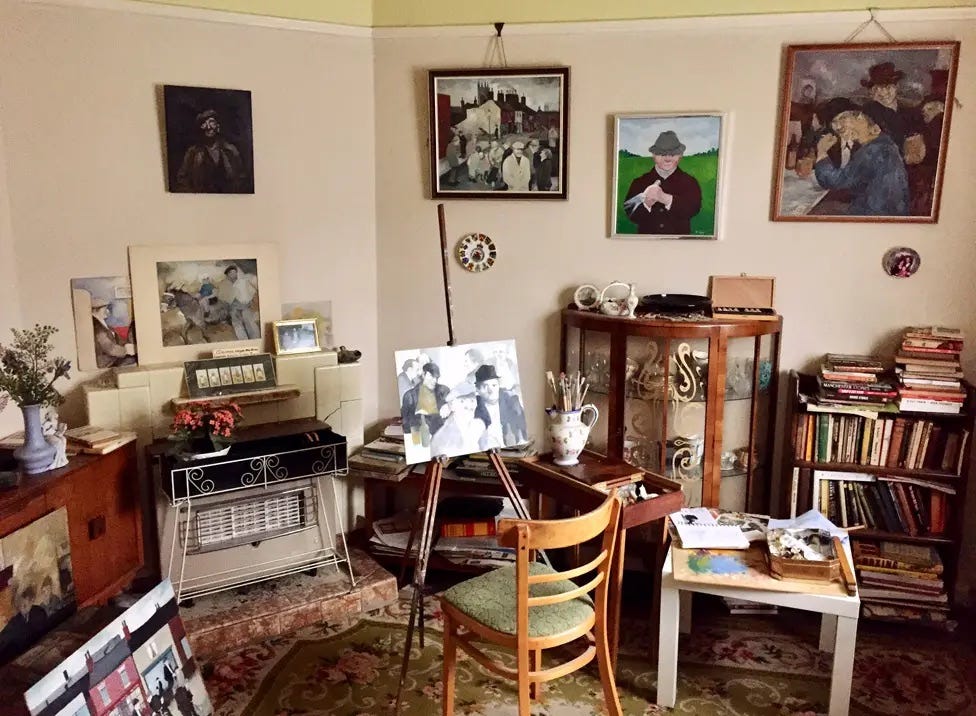
Picture Credit - Tony Tucker - Eric Tucker’s parlour, which was recreated in the exhibition of his work held in Warrington Museum & Art Gallery
ART IS ABOUT WHAT YOU CAN GET AWAY WITH
The famous quote by Andy Warhol about art being what you can get away with is often repeated.
This was indeed pertinent when you put it in the context of the 1960’ and 1970’s, when Warhol and his ilk were pushing the boundaries of what an artist can produce to convince the public, critics, or market that something is art, regardless of whether it lacks traditional skill or form.
That is certainly one way of looking at art and the way it can constantly be pushing the boundaries of what is expected.
As for Eric Tucker, the work he left behind and the excellent book of his life The Secret Painter, leaves me asking myself a number of questions, like -
What is art ?, What is art for ?, Who is art for ?, Who decides what it is ? Why is it still more exclusive than it should be ? Why is the supposed cultural elite chock full of hypocrisy and snobbery ? Why has social mobility stalled so badly ? Why is social class still such an impediment to participation in the arts ?
I don’t pretend to have the answers but these are questions which are as old as the hills.
Art is, of course all subjective just like writing, dance, film, theatre, music, fashion, architecture etc, but what of Eric Tucker and his body of work ?
A WINDOW INTO HIS WORLD
In my view, art is all about telling the story of what you see around you at a certain moment in time. I suppose that is the historian in me, edging toward that view.
Eric Tucker did exactly that, through the lens of working class people, in places that they lived, worked, laughed, played, cried and celebrated. They were his people, often characters on the margins – with whom he felt a great affinity.
The following quote sits well with my interpretation of his work -
‘Now that his art has at last been rescued from undeserved obscurity, it enables us to share a whole range of vividly defined emotions and experiences at the very heart of northern working-class life.’ (Richard Cork, art historian, critic, broadcaster & curator).
He gave us a glimpse into his world and provided a wide open window into life in a Northern industrial town.
In his life he kept his work hidden but in his death he put his people, town, family and himself on the map.
THE SECRET PAINTER
If you haven’t read the biography of Eric Tucker - The Secret Painter, I cannot recommend it strongly enough. It will leave you asking plenty of questions about art and culture and the way we view it.
The book is uplifting, inspiring, jaw dropping, moving, witty, illuminating and a sharp reminder that creativity can flourish against all odds in the most inhospitable circumstances.
The final question that it poses for me is - how many hundreds, if not thousands of Eric Tuckers are there out in our communities ? And how can we provide better opportunities and a more open environment for them to feel comfortable to show their work ? How many have we missed ?
As Jarvis Cocker asserts - “ A timely reminder that art did not originate as an investment opportunity or a get rich quick scheme but as a way for human beings to make sense of their lives (plus make them bearable into the bargain). Miracles happen in the most unlikely places “.
I will leave the final words with his nephew Joe Tucker, the author of The Secret Painter -
“His work for me is funny, quirky, direct and humane, though at times there is a sense of unease, even dislocation. He made his own world and peopled it. In its’ unalloyed rootedness he offers us a sense of the universal. And that surely must be the mark of a true artist. “
FURTHER READING
Eric Tucker Website - https://www.erictucker.co.uk/about
The Secret Lowry - The Guardian - https://www.theguardian.com/artanddesign/2025/jan/23/secret-lowry-gravedigger-eric-tucker-northern-life-factory-pub
The Secret Painter Book by Joe Tucker - https://www.erictucker.co.uk/home
Thank you for sharing Eric’s story, Anthony. I’m adding his biography to my reading list.
Your gift with words did that thing that words do best: sparked my interest but more, sparked my imagination.
It rings true here in the States as well as in the UK that there must be countless artists working in silence, even secrecy. Artists working in all media: painting, poetry, music. Craftsmen and craftswomen, too, working with needles, potting wheels, driftwood.
Thanks again for this wonderful article. ❤️
Presently I’m house-sitting in a small flat that looks very much like this. His mother’s mix of antique and contemporary furniture sits alongside his paintings covering the walls. They’re tucked into closets, stacked to the ceiling, hidden behind doors, balanced on top of rows and rows of books. He is currently walking the Camino de Santiago and will no doubt return with a cache of photographs for more of his quietly remarkable work.