
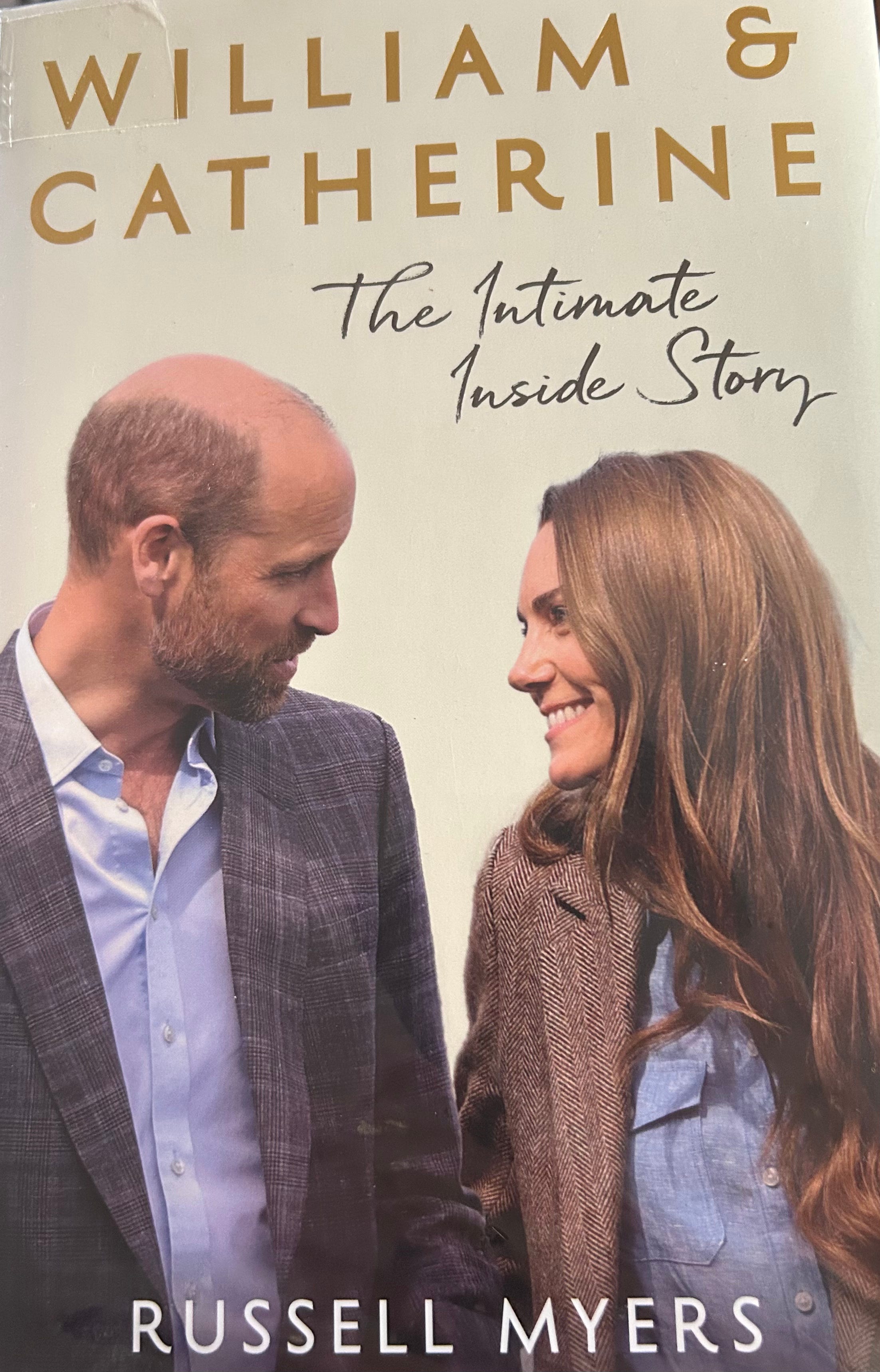
WILLIAM AND CATHERINE
The Intimate Inside Story by Russell Myers

WAITING IN THE WINGS
Having just finished reading the excellent biography of Prince William and Princess Catherine by Russell Myers, I wanted to use this piece to look at what they may bring to the top job as and when it comes their way.
Hopefully, it will not be for many years yet but even so, it is interesting to get some idea of what they might prioritise in their reign.
This article will not be a full review of William and Catherine - The Intimate Inside Story, but will focus on aspects raised in the tome relating to the way they see themselves developing and evolving the Monarchy.
As an aside the book is a very good read and does give an insight into the characters of William and Catherine, what makes them tick, what their priorities and influences are.
More than enough has been, and continues to be written and said about Harry and Meghan - the Duke and Duchess of Sussex, Andrew Mountbatten Windsor and Sarah Ferguson, and Princesses Beatrice and Eugenie. So they won’t feature in this piece in great detail.
The book covers the strained relationships between Prince William and Princess Catherine with the Sussexes and the former Yorks. It also looks at their differences of opinion with King Charles III on how the two counties should be handled. But, I will leave that for readers to discover for themselves in the book.
As we are now over 3 years into the new Carolean era, and knowing that the King is clearly struggling with cancer and the treatments that are prescribed, it is clear that Prince William and Princess Catherine are being groomed for the top job, quietly waiting in the wings.
Whether or not we are Monarchists ( I am one myself, although it needs major reform ) it is interesting to get an idea of what they might prioritise as and when they reign.
Here is my take on what King William V and Queen Catherine may deliver.
IT’S A FAMILY AFFAIR
The most important thing for William and Catherine is family. It is their main priority. They believe that having solid family foundations of their own can help them build a Monarchy fit for modern times.
The first part of the book looks at their upbringings, education and life experiences, including their courtship. Like most of us, those early lessons frame our lives so very strongly.
Readers of the book will be reminded of the difficult childhood that Prince William experienced, living his life in the full glare of feverish publicity, his parents desperately unhappy in a failed marriage, and his Mother killed when he was just 15 years old.
In complete contrast to this, Catherine lived a very happy, stable childhood. In many ways, William has embraced that love and warmth from his in laws, seeing it as a vital stabilising factor in his life and that of his own family.
They are determined to raise their own children in as “normal”, a way as possible. Above all else, they want to be a tight, happy, and supportive family of five. From doing the school run, to taking the children to football matches and on nature walks, it is a family affair.
Normal is something that William has always craved. It is why he chose to go to St Andrews University in Scotland rather than Cambridge as his father did, and why he opted to take up his role as a search and rescue pilot between 2010 and 2013, in Anglesey , Wales at RAF Valley.
Later in Norfolk full-time from 2015 to 2017 while working as an air ambulance pilot for East Anglian Air Ambulance, William again chose the peace and quiet of Angmer Hall.
He wanted to be away as much as possible from the limelight, to have enough time to enjoy his family and think about the way he wanted to use his profile to its’ best advantage.
The importance of that solid family foundation was forensically examined, when in 2024, King Charles and Princess Catherine were both diagnosed with cancer.
The book gives an incredibly moving account of how that dreadful news unfolded and how William and Catherine faced up to it .
A close friend of William’s said - “It was like being hit by a bus, sudden, brutal and completely disorienting. One moment life was normal, and the next, everything changed”.
ROYAL WITH A SMALL r
So how does the book suggest that William and Catherine will reign when the time comes ?
Royal with a small r is how William describes how they intend to develop the Monarchy.
The institution would see less formality, fewer visits to the dressing up box and a shorter Coronation. (His Father’s was 3 hours and his Grandmother’s 4 hours ). He envisages a Coronation ceremony of about one and a half hours.
One thing to emphasise is that William, unlike his Father and Grandmother does not believe in the divine right of Kings. This will no doubt ruffle a few feathers in Establishment circles.
The small r will focus more on “ impact, philanthropy, collaboration, convening and helping people “.
They acknowledge that the institution itself needs to be seen as something that offers “continuity and opportunity for renewal”.
Tradition will always play a big part. Pomp and circumstance are what we do but William and Catherine believe that things must evolve and be done with modern sensibilities.
In a BBC interview, William outlined - “the need for the Monarchy to modernise and develop in order to survive”. He continued - “ As it goes along, it has to stay relevant and that’s the challenge for me, how do I make the Royal Family relevant in the next 20 years time …? “
It is clear that they wish to be more in tune with what ordinary people think, feel and live through. They see collaboration at work as the way to get the best results for the most amount of people.
They aim to be more about compassion, service and a deep commitment to others. But again they believe that this can only happen with a solid family foundation.
LESS IS MORE - QUALITY NOT QUANTITY
As for their charity work, they believe that it is important to focus on fewer projects but provide more energy and attention to them.
They will provide greater emphasis on each of their causes and still very importantly, spend valuable time with their three children and wider family(s).
They are well aware that concentrating on a smaller number of projects may draw criticism, especially the accusation of being “work shy”.
On the other hand if they push too hard on some of their programmes like Earthshot, Homewards and the Centre for Early Development, which all have political implications, they may be interpreted as meddling with Government policy.
The basis of their work will be focused on the basic needs of society. So environmental protection, mental health, focus on the early years, addictions, homelessness, all reflect the underlying principles of the people they are.
EVOLUTION NOT REVOLUTION - CHANGE FOR GOOD
Gradual, meaningful change but not disruption, disturbance and upheaval is the way that the book portrays the approach of William and Catherine.
Many will not be aware that it was Prince William who lobbied his Grandmother Queen Elizabeth II to change the ridiculous rules of male primogeniture, whereby the Monarchy would be ascended by the oldest male(s) over and above any older female(s).
The shift came with - The Succession to the Crown Act 2013, enacted in 2015, which abolished the old rule where younger brothers displaced elder sisters. Princess Charlotte (born 2015) will be the first female royal to benefit from this, retaining her place ahead of her younger brother, Prince Louis.
Their vision instinctively upholds the values and traditions of the past, yet isn’t afraid to make changes and lead in a bold new direction.
William suggests - “ I enjoy that change, I don’t fear it. That’s the bit that excites me, the idea of being able to bring some change, not overly radical change nut changes that I think need to happen”.
He continues - “ I think it’s very important that tradition stays, and tradition has a huge part in all this. But there’s also points where you look at tradition and go : Is that still fit for purpose today ? Is that still the right thing to do ? Are we still doing and having the most impact we could be having ? ‘.
THE ART OF THE POSSIBLE
“The art of the possible “- is a quote from former British politician R A Butler, and it is very apt for the situation that William and Catherine may face.
It is easy for them and indeed any of us to suggest what is wrong with the Monarchy and how it can be tackled but when in situ, it is about what you can achieve not necessarily what you would wish to achieve.
Any change in the UK is usually accompanied by plenty of kicking and screaming, so let’s not pretend that reform will be easy or fast.
That the Monarchy needs reforming and modernising is very clear. To make the institution more relevant, credible and fit for the 21st Century is a huge challenge.
With the ongoing scandal and investigation into the alleged misdeeds of Andrew Mountbatten Windsor and possibly his ex wife and children, plus the continuing divorce of the Sussexes from the Royal family, some decisive action will need to be taken .
A DOOR AJAR, BLOWN WIDE OPEN BY ANDREW MOUNTBATTEN WINDSOR
The problems that have arisen for the Royal family stem from them being over protected. The institution is too secretive without sufficient scrutiny and not transparent or accountable. These deficiencies have allowed misdemeanours to be committed and covered up, by the looks of it.
It has become an easy way for potential enemies to inveigle their way into the UK establishment. The Royal family is not monitored or policed closely. So for adversaries of the British state, the Royal door is ajar and has been far too easy to push open.
In a way the Andrew Mountbatten Windsor scandal has blown that door off its’ hinges and now provides an opportunity for the necessary reforms to take place.
In my view, Parliament must start doing more to push this. Let’s see but I cannot believe that the status quo will be preserved.
So the challenge for the institution is to become far more transparent especially around their finances, funding, properties and charity work.
FINE WORDS DON’T BUTTER ANY PARSNIPS
A clear statement needs to be made about all non working Royals. None of them should be permitted to use their Royal titles to make financial or material gain.
Those who have used their titles for such gain, should have titles and privileges withdrawn. This should include grace and favour accommodation and removal from the official Royal succession list and official website. Oh and no state funded security.
An audit of all Royal properties needs to be undertaken and more access to some of them given to the public. Surely some of these properties could be used in ways to benefit the people ?
Income tax, inheritance tax and their payment by the Royals needs to be introduced and clearly declared for public scrutiny, as well as a Register of interests.
William is believed to want to reduce the pomp and circumstance. He envisages fewer visits to the dressing up box, albeit he won’t be appearing in an Aston Villa shirt anytime soon.
As ever, with any reform and change, the proof of the pudding will be in the eating and it will be done gradually as it always is in the UK.
That said, a number of commentators have suggested that William may not be as strong a reformer as we might envisage.
The author of Entitled - The Rise and Fall of The House of York, Andrew Lownie feels that like his father, William will be reluctant to make the financial side of the institution more open.
Certainly the Duchy of Cornwall and Lancaster need to be more open to scrutiny.
That the Monarchy as an institution badly needs to adapt to the modern World, is obvious but just what any new Gulielmian era can achieve is hard to predict given the seemingly endless Global turmoil.
Talk is cheap when you are not in the top job, and it may hopefully be a good few years before William ascends the throne, but undoubtedly reform must come, if the institution is to not just survive but thrive in the future.
Wonderful article, thank you. The royals do pay income tax. They don't pay income tax on what is passed monarch to monarch other family members do pay inheritance tax thats why Princess Margaret's children had to sell much of her jewels to pay the tax. More financial transparency and public access to buildings owned in the public trust should be implemented. The monarch's portfolio should be analyzed there aren't any nefarious investments. Most wealthy families use trusts to avoid large inheritance tax bills like the Duke of Westminster for example. If the taxation becomes so arduous and the monarch's wealth too diminished there is a tipping point where the duty, scrutiny and restrictions become an extreme burden not worth bearing. The monarch pays all of the working royals a salary out of their private funds. Their wealth has to sustain the monarchy in perpetuity. We have seen in other royal families like Spain their lack of wealth made them vulnerable to corruption. Just my two cents from America.
I really enjoyed your article and am very much in agreement with you regarding transparency and accountability. I can see that some want the monarchy to evolve overnight, which is unlikely and fraught with many minefields. With that said, I think if they could make small changes, sort of dipping one’s toe in the tub to see if it too hot, many people would appreciate and support their efforts. Maybe the could start with a code of conduct for all working royals, a public registry of public and private gifts and oversight of earning monies from external entities and individuals. Just some thoughts!